Store locations
A store needs a well-organized warehouse, even if it is small.
To make it easier to find items or their variants (e.g. other sizes or colours), it is important to follow a system of order and classification.
Additionally, at peak times, employees should focus on serving customers and not arranging or checking inventory. That's why WMS operations (which involve scanning each item at pickup) are too complex and time-consuming.
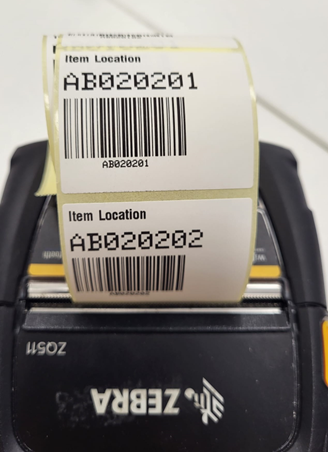
In ICS, a warehouse map is created and a unique code is assigned to each product.
When an employee needs to find a specific product, he enters its code into the application and receives indications about the exact location in the warehouse where the product is located.
The location of items in the store is fixed and out of stock per location. This means that the location is indicative — it indicates where a product is usually located (on which shelf, in which area), but no on/off site operations are carried out as in the WMS.
The concept is: product displayed on the shelf + additional stock in the store's internal warehouse. The seller scans a product, sees the location in the internal warehouse, and can find another size or color without visually searching.
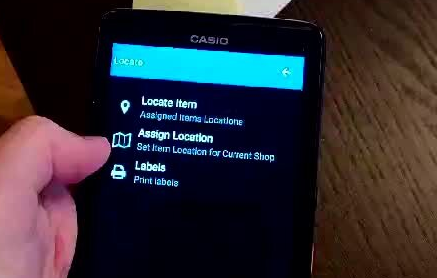
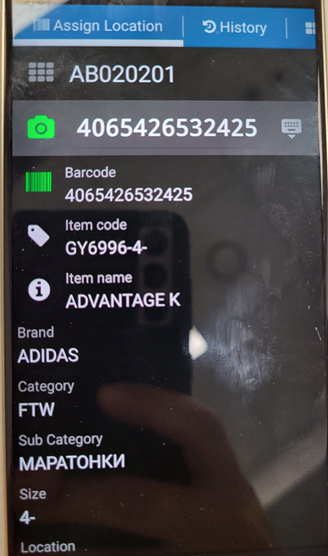
Assigning two locations to one item is not possible in our system.
This is designed to simplify the inventory management and avoid confusion.
For instance, if you want to move an item to a different location, you just need to scan the new location barcode.
If you could assign two locations to one item, you would have to keep track of which location is active and which is not.
This would make the location management more complicated and harder to train the staff in the stores.
Warehouse locations (WMS)
In warehouses, the location is structured on 4 levels: Row (10, 11, 12...) → Depth (1, 2, 3...) → Height (A, B, C, D) → Shelf/Pallet (1, 2, 3).
All scanning operations involve removal or location. The operator is guided on an optimized route that takes into account: location, volume, weight and other configurable priorities.
Standard mode — the operator can pick up or drop off goods from/to locations other than those suggested. It offers flexibility.
Advanced mode — locations are forced; The operator must follow the route and locations indicated exactly. It offers maximum speed, but exceeds the resources and needs of most warehouses.
<!-- SCREENSHOT: WMS — 4-level location, guided route -->